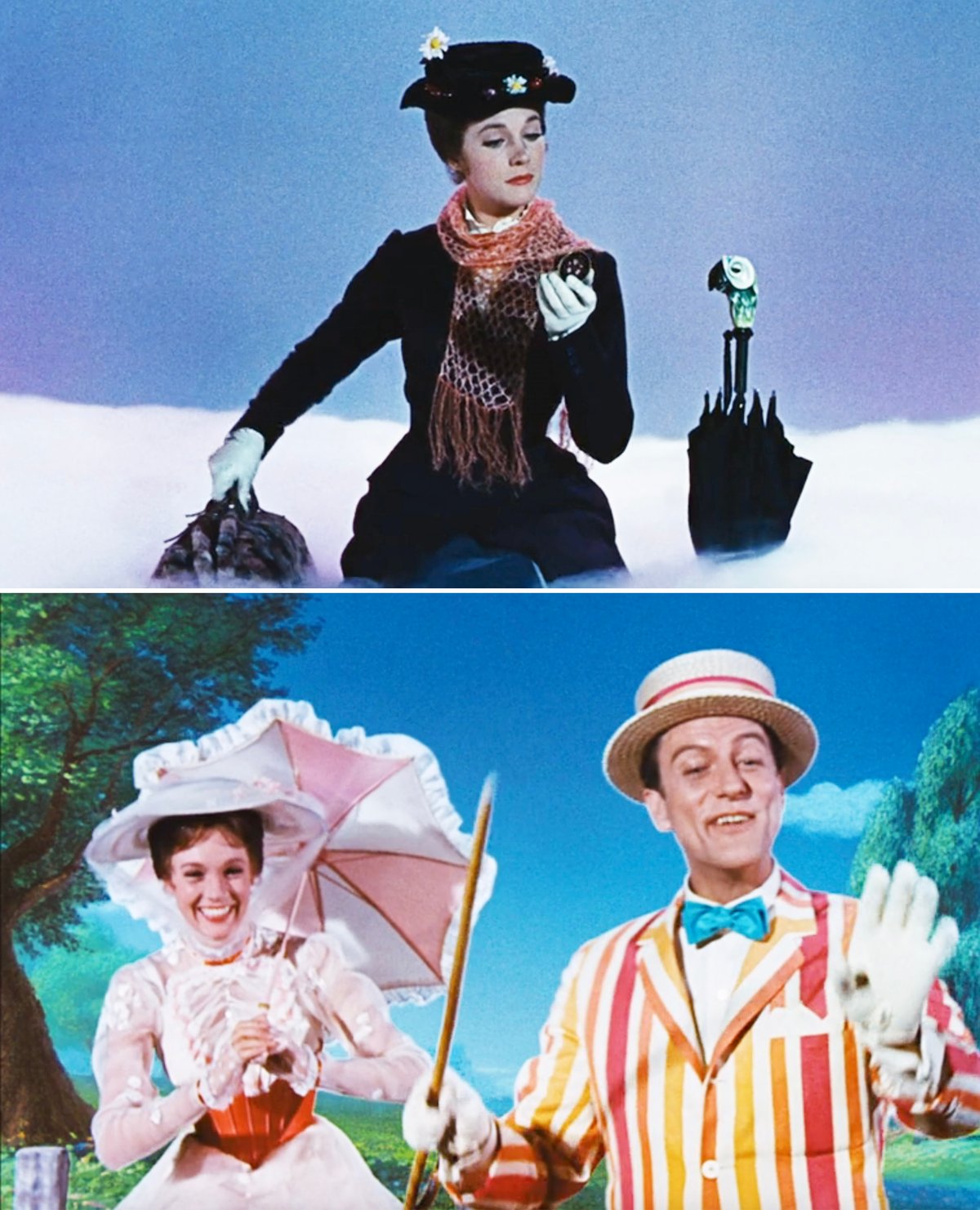
The wind shifts, a familiar tune dances on the breeze, and a practically perfect nanny floats into view. For generations, Mary Poppins has captivated audiences with its vibrant magic, unforgettable songs, and heartwarming story. But beneath the seemingly effortless spectacle lies a tale of artistic struggle, relentless ambition, and ingenious creativity. It's a journey that began long before the cameras rolled, a testament to Walt Disney's vision and the dedicated craftspeople who brought P.L. Travers' beloved character to life.
Today, we're pulling back the curtain to reveal some of the most fascinating Behind-the-Scenes Mary Poppins Facts that shaped this cinematic masterpiece. You might think you know this film inside out, but prepare to discover the hidden magic behind the magic – the real-life triumphs and challenges that made Mary Poppins practically perfect in every way.
At a Glance: Peeking Behind the Practically Perfect Curtain
- A 21-Year Pursuit: Walt Disney spent over two decades convincing author P.L. Travers to sell him the film rights.
- Julie Andrews' Reluctance: The future Oscar winner nearly passed on the role, feeling overlooked for My Fair Lady.
- Dick Van Dyke's Double Role: He begged Walt Disney to play Mr. Dawes Sr., even working for free (with a charitable twist!).
- Hand-Painted London: The iconic cityscape wasn't just a set; it was a meticulously painted backdrop with clever lighting tricks.
- No Blue Screen, More Color: Special effects pioneers found a way to use a multi-colored backdrop for the animated sequences, allowing Bert's blue bowtie to shine.
- The Carpet Bag Secret: Mary Poppins' bottomless bag was a clever combination of practical effects and camera trickery.
- Unused Songs and Recycled Melodies: Several Sherman Brothers' tunes, including an initial introduction for Mary Poppins, were cut but found new life.
- Costume "Easter Eggs": Designer Tony Walton wove hidden details into Mary Poppins' outfits, providing Julie Andrews with character insights.
A Practically Perfect Pursuit: Walt, Travers, and a 21-Year Marathon
Imagine wanting something so badly you pursue it for over two decades. That was Walt Disney's reality when it came to Mary Poppins. The year was 1938, just four years after P.L. Travers' first book introduced the world to the enigmatic nanny. Disney, ever the visionary, saw the cinematic potential immediately. But Travers? She was a formidable opponent, fiercely protective of her creation, and repeatedly refused Disney's overtures for 21 long years.
Her apprehension wasn't unfounded; Travers had a very specific, often darker, vision for Mary Poppins that she feared Hollywood would dilute. She wanted control, nuance, and a faithful adaptation of her intricate world. It wasn't until 1959 that she finally relented, swayed by Disney's unwavering charm and perhaps the sheer persistence that bordered on obsession. Even then, her agreement came with a non-negotiable stipulation: "final say" on the script.
Travers herself described her interactions with Disney as being "like talking to a friendly, charming uncle who took from his pocket a gold pocketwatch and dangled it enticingly before your eyes." It was a delicate dance of persuasion, respect, and subtle manipulation. For two painstaking years, the script was adapted, rewritten, and debated. Travers flew to Los Angeles, a constant presence in the script meetings, offering critical feedback that was often scathing. She initially "didn't like anything" but eventually, after many revisions, signed off, receiving a consultant credit that belied her immense, often contentious, influence on the final product.
Casting Call: The Unlikely Choices That Made Icons
Bringing Mary Poppins and her whimsical world to life required more than just a script; it demanded the perfect ensemble. The casting process for Mary Poppins is a story of intuition, missed opportunities, and pure, unadulterated passion.
Julie Andrews' Hesitation and Triumph
When it came to Mary Poppins herself, Walt Disney and the songwriting Sherman brothers had only one name in mind: Julie Andrews. They had been captivated by her performance in the Broadway musical Camelot. Disney flew to New York specifically to see her on stage and immediately extended an invitation for Andrews and her then-husband, Tony Walton, to come to Los Angeles. There, they were treated to a viewing of the film's storyboards, a rare honor that demonstrated Disney's conviction.
However, Andrews had reservations. At the time, she was the logical and critically acclaimed choice to star as Eliza Doolittle in the film version of My Fair Lady, a role she had originated on Broadway. When she was famously passed over for Audrey Hepburn, a crushing blow to her budding film career aspirations, it reinforced a deep-seated insecurity that she wasn't "pretty enough" for movies. Disney, with his legendary perceptiveness, knew exactly what to say to reassure her, telling her that she "must" play Mary Poppins and that the studio would wait for her to finish her pregnancy. This vote of confidence, combined with the sting of My Fair Lady, ultimately convinced Andrews to take on the role that would win her an Academy Award and cement her place in cinematic history. It was her cinematic debut, a truly "practically perfect" beginning.
Dick Van Dyke's Double Act and Controversial Accent
One of the film's most memorable, and perhaps most debated, performances came from Dick Van Dyke as Bert, the chimney sweep. But did you know he played another character? Van Dyke absolutely "begged" Walt Disney to play the role of Mr. Dawes Sr., the ancient, crotchety head of the bank. His passion for the character was so strong that he even offered to work for free.
Disney, ever the shrewd businessman and philanthropist, accepted the offer. However, he had a condition: Van Dyke had to donate $4,000 to the California Institute of the Arts (CalArts), an institution co-founded by Disney himself. Van Dyke gamely agreed. To secure the role, he also had to screentest as Mr. Dawes Sr. as a joke, which was described as "hilarious, totally persuasive and completely unrecognizable." His transformation was so complete that some viewers still don't realize it's him!
While his performance as Bert is iconic, his Cockney accent has been a source of both amusement and criticism. He sought help from Irish actor J. Pat O'Malley, but British audiences have affectionately (or perhaps pointedly) commented on its perceived inaccuracy for decades. It's a charming quirk that adds to the film's unique flavor.
A Familiar Face in the Park: Angela Lansbury
Keep your eyes peeled during the park scenes, and you might spot another legendary talent in a brief cameo. The incomparable Angela Lansbury made an appearance as a woman selling balloons in the park. It's a blink-and-you'll-miss-it moment, but a delightful nod to a career that would later see her become a Disney legend in her own right, famously lending her voice to Mrs. Potts in Beauty and the Beast.
Crafting Cinematic Wonders: The Art of Illusion
Mary Poppins was a groundbreaking film for its time, seamlessly blending live-action with animation, and employing special effects that dazzled audiences. The magic wasn't always achieved with computers; often, it was the result of painstaking artistry and clever practical ingenuity.
The Hand-Painted London: A City Brought to Life
One of the most visually stunning elements of the film is the iconic London cityscape that serves as the backdrop for many of the animated sequences. This wasn't a computer-generated image or a miniature model. Instead, artist Peter Ellenshaw, a long-time collaborator with Disney who had previously worked on films like Treasure Island and 20,000 Leagues Under the Sea, hand-painted the entire panorama.
His artistry didn't stop at painting. Ellenshaw purposefully added small, strategically placed holes within the painted backdrop. Behind these holes, lights were positioned, creating the illusion of twinkling city lights and adding a profound sense of depth and reality to the two-dimensional artwork. It's a testament to the meticulous attention to detail that defined the production.
"Jolly Holiday": A First for Andrews, a Breakthrough for Effects
The "Jolly Holiday" sequence, where Bert and Mary Poppins jump into his chalk drawing, was a pivotal moment not just for the film's narrative but for its production as well. Remarkably, it was the first scene filmed for Mary Poppins, marking Julie Andrews' cinematic debut. Imagine the pressure!
This sequence was also a masterclass in integrating live-action with animation. Crucially, the production team avoided using a traditional blue backdrop for their special effects. At the time, blue screen technology would have made it difficult to incorporate blue colors into costumes or props without them becoming transparent. By opting for a different, often multi-colored, backdrop technique, the filmmakers opened up a wider range of costume colors, which is why Bert's vibrant blue bowtie could shine so brilliantly against the animated world. This choice allowed for the rich palette that makes the "Jolly Holiday" sequence so visually enchanting. Explore Mary Poppins filming and discover more about these innovative techniques that set new standards for cinematic magic.
The Magical Carpet Bag Unravelled
Mary Poppins' seemingly bottomless carpet bag, from which she pulls everything from a hat stand to a towering plant, is one of the film's most charming visual gags. How did they achieve this impossible feat?
It was a clever combination of filming techniques and precise stagecraft. In one instance, a special table was constructed with a hidden compartment underneath. A crew member would be concealed beneath the table, feeding items through the opening into the bag as Julie Andrews "pulled" them out. For the reactions of Karen Dotrice (Jane Banks) and Matthew Garber (Michael Banks), they were filmed genuinely reacting to an empty, clear table, which was later combined with the footage of Andrews. The seamless editing made it appear as though the items truly materialized from thin air.
Harnessing the Heavens: Poppins' Flight
Mary Poppins' elegant flights through the London sky are among the film's most iconic images. To achieve this, Julie Andrews spent considerable time suspended by a harness. While the effect on screen is graceful, the reality was less so. Andrews recounted that despite extra padding like sheepskin, the harness caused bruising on her hip bones, a small price to pay for such a memorable performance. The physical demands on the actors to bring these magical elements to life were often immense.
The Musical Heartbeat: From Score to Screen
The Sherman brothers, Robert and Richard, composed the iconic soundtrack for Mary Poppins, creating songs that are now woven into the fabric of popular culture. Their creative process was rigorous, with many ideas explored and discarded along the way.
Global Inspirations and Lost Melodies
In their initial writing phase, the Sherman brothers drew inspiration from various locations mentioned in the book's spinning compass. They wrote songs like "North Pole Polka" and "The Land of Sand." While "North Pole Polka" didn't make the final cut, the melody for "The Land of Sand" found new life later on. If it sounds familiar, that's because its enchanting tune was repurposed for "Trust In Me," the slithery song Kaa sings in Disney's 1967 animated classic, The Jungle Book. It's a fascinating example of how creative ideas can evolve and find a perfect home elsewhere.
Another noteworthy cut was "Practically Perfect," a song initially intended to introduce Mary Poppins to the Banks children. While the full song was omitted, its melody was subtly utilized in the film's score, a ghost of a tune that still whispers through the soundtrack.
Glynis Johns' Demand for a Song
Glynis Johns, who played the spirited suffragette Mrs. Banks, was a seasoned performer and made a specific request to Walt Disney: she wanted her own musical number. Disney, perhaps caught off guard, made a promise on the spot, assuring her he would find her a song. The catch? It hadn't been written yet. True to his word, the Sherman brothers delivered, composing the delightful "Sister Suffragette," a rousing anthem that perfectly captured Mrs. Banks' passionate spirit and provided Johns with the memorable moment she deserved.
Costume Secrets and Hidden Details
Beyond the grand special effects and unforgettable music, the film's costumes played a crucial role in bringing the characters to life, often with hidden layers of meaning and practical considerations.
Tony Walton's "Easter Eggs" and Character Insights
Costume and set designer Tony Walton, Julie Andrews' then-husband, was a master of subtle detail. He concealed intricate "Easter eggs" and thoughtful touches within the lining of Mary Poppins' seemingly formal outfits. These weren't just decorative; they were designed to help Julie Andrews understand the complex character she was portraying. Walton explained that these hidden details were meant to convey Mary Poppins' "formal on the outside and a little bit wicked on the inside" personality, giving Andrews a deeper connection to the enigmatic nanny. It was a beautiful collaboration between actor and designer, adding depth to a character who is often prim but always unpredictable.
Practical Challenges: Duplicating Costumes for Harnesses
While the costumes were meticulously designed for aesthetics and character, they also had to accommodate the practicalities of a special effects-heavy film. Many of Mary Poppins' costumes, especially those used for flying sequences, were duplicated in a larger size. This allowed space for Julie Andrews' harness to be worn underneath without visibly distorting the silhouette, ensuring that her airborne grace looked effortless on screen, even if the experience was less comfortable for the actress.
The Dance of Demanding Choreography
Mary Poppins is a musical, and as such, dance plays a vital role in its storytelling. Some numbers, like the iconic "Step In Time," required extraordinary dedication and precise execution.
"Step In Time": A Masterpiece of Movement
The "Step In Time" musical number, featuring Bert and a troupe of chimney sweeps dancing across the rooftops of London, is one of the most energetic and visually complex sequences in the film. Unlike some of the other songs, which could be filmed with more spontaneity, this number required extensive rehearsals. The demanding choreography, intricate formations, and the sheer number of performers meant that every step, every toss of a broom, had to be perfectly synchronized. The result is a breathtaking display of movement that feels both joyous and meticulously planned, a true highlight of the film's incredible artistry.
Beyond the Screen: A Lasting Legacy
Mary Poppins isn't just a movie; it's a cultural touchstone. It represents a monumental effort in filmmaking, pushing boundaries in storytelling, music, and special effects. The tireless dedication of Walt Disney, the unwavering commitment of P.L. Travers (despite her initial resistance), and the phenomenal talents of the cast and crew converged to create something truly magical.
Knowing these behind-the-scenes facts enriches the experience of watching the film, transforming it from a simple viewing into an appreciation of the artistry, ingenuity, and sheer force of will that brought it to life. So the next time you hear a Spoonful of Sugar or watch Mary Poppins glide across the sky, take a moment to remember the human magic behind the cinematic magic. It's a tale as rich and layered as the carpet bag itself, proving that sometimes, the most extraordinary adventures happen long before the final cut.